
To price a retail arbitrage buy, start from three numbers: your landed cost, the marketplace fees at your target price, and the lowest price you'll accept. List near the current Buy Box price, not the lowest offer on the page, and never below your floor. Then let the price move with the Buy Box, inside a min and max you set once.
That sounds obvious. But most RA and OA sellers do it backwards. They find the lowest price on the listing, knock a penny off, and hope volume makes up for it. It usually doesn't. The lowest offer is often an FBM seller with slow shipping or a new account that isn't winning the Buy Box anyway. Undercut them and you've given away margin for nothing. (We dig into why in You're matching the lowest price and still losing the Buy Box.)
The three numbers to know before you list
1. Landed cost. Not the sticker price. Landed cost is what the unit cost you to get into a fulfillment center: purchase price, sales tax, your share of shipping to the warehouse or prep center, prep and labeling, and any inbound placement fee. On a cheap clearance buy, those extras add up fast: in the example below they add about 14% to the receipt price. If you don't count them, your "profitable" flips are thinner than you think.
2. Fees at your target price. Both marketplaces charge a referral fee, which is a percentage of the sale price, so it moves when your price moves. Fulfillment fees (FBA or WFS) are fixed by size and weight. Storage adds a little every month the unit sits. Run the fees at the price you expect to sell at, not the price you hope for.
3. Your floor. This is the lowest price you'll sell at. It equals landed cost plus fees plus the minimum profit you require per unit. The floor is the number that protects you when a price war starts. You can set it by ROI, profit margin or a fixed profit per unit; profit protection shows how Flashpricer calculates it from your cost and fees.
Pricing at launch vs once you have the Buy Box
When you first list, you're usually not in the Buy Box yet. You need to price competitively enough to get into rotation, but there's no reason to start a race.
At launch, look at who actually holds the Buy Box, not who has the lowest price. Price at or just under the Buy Box winner if you're fulfilled the same way (FBA vs FBA, WFS vs WFS). If the winner is FBM and you're FBA, you can often match or sit slightly above and still win, because fulfillment and delivery speed count.
Once you're winning the Buy Box, the job changes. Now the goal is to stay in it at the highest price the listing will bear. That means raising your price when competitors run out of stock or drift up, and only dropping when someone actually takes the Buy Box from you. Sellers who only ever lower prices leave real money on every listing they win. More on that in how to win and keep the Buy Box at the highest price.
Amazon vs Walmart: why the same item can carry a different price on each
It's tempting to list an arbitrage item at the same price everywhere. Don't. The right price differs by marketplace for three reasons:
- Fees differ. Amazon FBA and Walmart WFS charge different fulfillment fees for the same box, and the weight tiers break at different points. Your floor on each marketplace is a different number. FBA and WFS compared walks through how the two services differ.
- Competition differs. A listing with nine sellers on Amazon might have two on Walmart. Fewer sellers usually means you can hold a higher price.
- The Buy Box isn't one national contest. On both marketplaces, the winner can change with the shopper's location and delivery speed, so you can be winning in one state and losing in another at the same moment. The Buy Box went local covers how that works and how to see it.
Q4 pricing for arbitrage inventory: when to hold and when to clear
Q4 is where arbitrage sellers make or lose the year. Two things are true at once: demand goes up, and so do storage costs. On Amazon, monthly storage for standard-size items costs roughly three times as much from October through December as the rest of the year (check the current rates in Seller Central, they change). On Walmart, WFS adds $1.50 per cubic foot per month, on top of the $0.75 base, for inventory stored more than 30 days between October 1 and December 31 (Walmart Fulfillment Services pricing (opens in a new tab), checked November 2026).
| Signal | Hold | Clear |
|---|---|---|
| Sales velocity | Selling steadily | Slow, or you bought too deep |
| Buy Box price | Stable or rising | Falling as new sellers pile in |
| Sell-through | Done before January | Units will still be there in January |
| What to do with your floor | Leave it, or raise it for the season | Lower it on purpose, for a set number of units |
Hold when the item is selling, the Buy Box price is stable or rising, and you'll sell through before January. Don't chase the price down in November. Demand is on your side. If anything, raise your floor for the season.
Clear when you bought too deep, sales velocity is slow, or the listing is flooding with new sellers. Clearing early in Q4, while shoppers are still buying, beats clearing in January at a deeper loss with a storage bill attached. Lower your floor on purpose, for a set number of units, and put it back once you've cleared what you meant to clear.
Worked example: one clearance item, from cost to listing price
Example SKU, made up but realistic. Fees are illustrative; pull your actual numbers from Amazon's fee preview and Walmart Seller Center before you list.
You find a boxed kitchen gadget on clearance for $8.00. Shipping weight is about 1.4 lb. Amazon has six offers with the Buy Box at $24.49. Walmart has two offers with the Buy Box at $22.97.
Step 1: Landed cost
| Cost line | Amount |
|---|---|
| Clearance price | $8.00 |
| Sales tax (6.35%) | $0.51 |
| Prep, labeling and inbound shipping (per unit) | $0.60 |
| Landed cost | $9.11 |
Step 2: Fees and floor on each marketplace. You want at least $3.00 profit per unit. Both marketplaces charge a 15% referral fee in this category.
| Item | Amazon (FBA) | Walmart (WFS) |
|---|---|---|
| Fulfillment fee | $5.50 | $4.95 |
| Inbound placement fee | $0.30 | none |
| Referral fee | 15% of price | 15% of price |
| Floor (min price) | $21.07 | $20.07 |
| Current Buy Box | $24.49 | $22.97 |
| Profit at Buy Box price | $5.91 | $5.46 |
The floor math on Amazon: ($9.11 + $5.50 + $0.30 + $3.00) ÷ 0.85 = $21.07. On Walmart: ($9.11 + $4.95 + $3.00) ÷ 0.85 = $20.07. The inbound shipping to WFS is already in your landed cost.
Step 3: Min, max and listing price
- Amazon: min $21.07, max $34.99 (set near the listing's 90-day high). List at $24.49 to match the Buy Box, since you're FBA like the winner.
- Walmart: min $20.07, max $32.99. List at $22.97. With only two sellers, there's no reason to undercut.
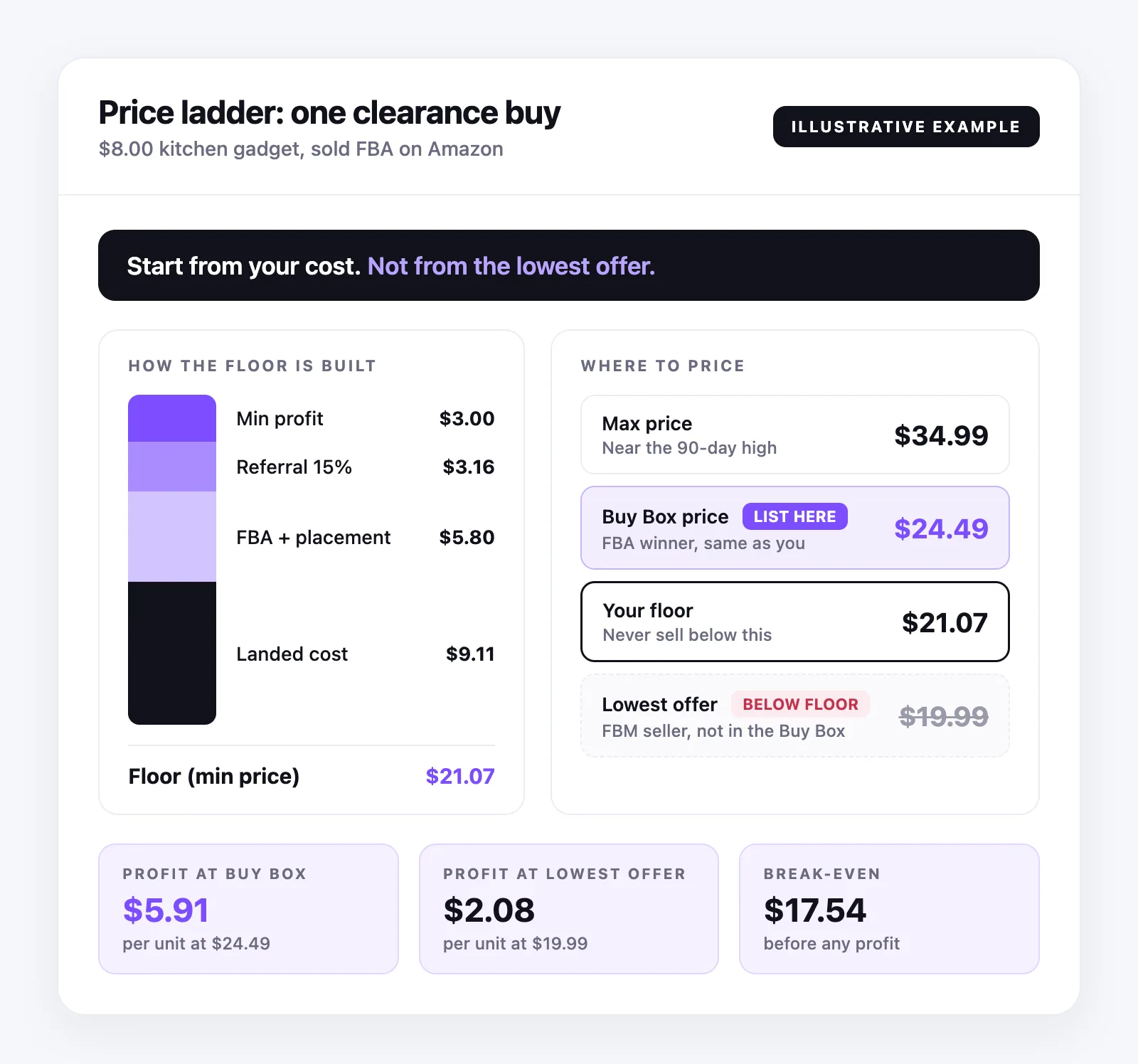
Notice what happens if you'd copied the lowest offer instead. If the cheapest Amazon offer is an FBM seller at $19.99, matching it puts you below your floor. You'd make $2.08 a unit instead of $5.91, less than the $3.00 you decided the flip was worth, and you probably still wouldn't win the Buy Box. Starting from your cost keeps you out of that trap.
How Flashpricer handles this
Flashpricer puts min and max guardrails on every listing, so the repricer can chase the Buy Box without ever crossing your floor. It can calculate that floor for you by ROI, margin or fixed profit per unit, from your cost plus FBA, WFS, FBM and referral fees, and costs sync from a spreadsheet or your inventory tool every 30 minutes.
It reprices Amazon and Walmart (US) from one account, with native Walmart support, so the same item can follow different rules on each marketplace. Once you win the Buy Box, rules like Don't Lower My Price hold your price instead of racing down. Setup takes about 15 minutes, and price changes are pushed in under 30 seconds on every plan; Walmart applies them almost instantly, while Amazon can take up to 4 minutes to publish them, the same for every repricer. See how it works for RA sellers on the retail arbitrage repricer page.
FAQ
How do I price retail arbitrage items on Amazon?
Start from landed cost plus Amazon's fees plus your minimum profit. That gives you a floor. Then list at or near the current Buy Box price, not the lowest offer, and let a repricer move you within your min and max.
Should I match the lowest price on an arbitrage listing?
Usually not. The lowest offer is often an FBM seller who isn't winning the Buy Box. Match the Buy Box winner if you're fulfilled the same way, and stay above your floor.
Should my Amazon and Walmart prices be the same?
No. Fees, competition and Buy Box rules differ, so the floor and the winning price differ. Set rules for each marketplace instead of one price.
What should I do with slow arbitrage inventory in Q4?
If it isn't selling by early November, lower your floor on purpose for a set number of units and clear them while demand is high. Waiting until January usually means a deeper cut plus peak storage fees.