
The best wholesale repricing strategy on Amazon is to stay in Buy Box rotation at a price that protects your margin, not to win the Buy Box outright by undercutting. On shared listings, Amazon rotates the Buy Box among competitive sellers. So matching the price band, keeping strong metrics and avoiding price wars usually earns more total profit than racing to the bottom.
If you came from private label or arbitrage, this takes some getting used to. In wholesale, you're rarely alone on a listing, and you never will be. The game isn't winning every sale. It's getting a fair share of sales at a price that's worth it.
Why wholesale is different from private label and arbitrage
Private label sellers usually own the listing. There's no Buy Box competition to speak of, so repricing is about demand and velocity: raise the price when sales are strong, lower it when they slow.
Arbitrage sellers are on shared listings too, but the inventory is one-off. You might have 20 units, sell through, and move on. Speed and margin on each flip matter most.
Wholesale is different on both counts. You're on shared listings with the same five to fifteen sellers, and you'll be restocking the same ASINs for months or years. Every price you set teaches your competitors' repricers how to react to you. Start a war on Monday and you're still fighting it in March.
Buy Box rotation on shared listings
When several sellers offer similar value (close prices, same fulfillment method, solid metrics), Amazon doesn't give one of them the Buy Box all day. It rotates it among them. Your share of the rotation depends on how competitive your offer is compared to the others in the group.
That has a big implication: you don't need the lowest price to get sales. You need to be in the group. Once you're in, a lower price might nudge your share up a bit, but it costs you margin on every unit you would have sold anyway.
Rules by competitor type
Not all competitors deserve the same response. Set your rules by who you're up against.
| Competitor | What to do | Why |
|---|---|---|
| Amazon on the listing | Match Amazon's price or sit slightly above; don't undercut | Amazon rarely loses a price war, and you can often still share the Buy Box at its price |
| FBA sellers | Match the lowest FBA price in the Buy Box group | Same fulfillment, so price and metrics decide rotation |
| FBM sellers | Sit a little above them if you're FBA | Fulfillment and delivery speed count, so FBA can win at a slightly higher price |
| New sellers with little feedback | Ignore them unless they're actually winning the Buy Box | A low price from a new account often doesn't win anything |
| A seller clearly dumping stock | Don't follow; wait for them to sell out | They'll be gone in days; your margin lasts all year |
In a repricer, each row is a rule: who to compete against, who to ignore, and what to do. Flashpricer's custom repricing rules are built around exactly those choices.
Avoiding price wars with other repricers
Most of your competitors run repricers too. Two repricers set to "beat the Buy Box by $0.01" will walk each other down to the floor in an afternoon. A few rules prevent that:
- Match, don't beat. If you're in the Buy Box group, matching the price keeps you in rotation without triggering everyone else to drop.
- Don't reprice against yourself. If you're already sharing the Buy Box, hold.
- Set a real floor. Your min price should include every fee and the profit you require. When the war hits your floor, you stop and they keep going alone.
- Raise when they leave. When competitors go out of stock, move your price back up. Most sellers forget this side.
Worked example: share it or own it
Example ASIN, made up but realistic.
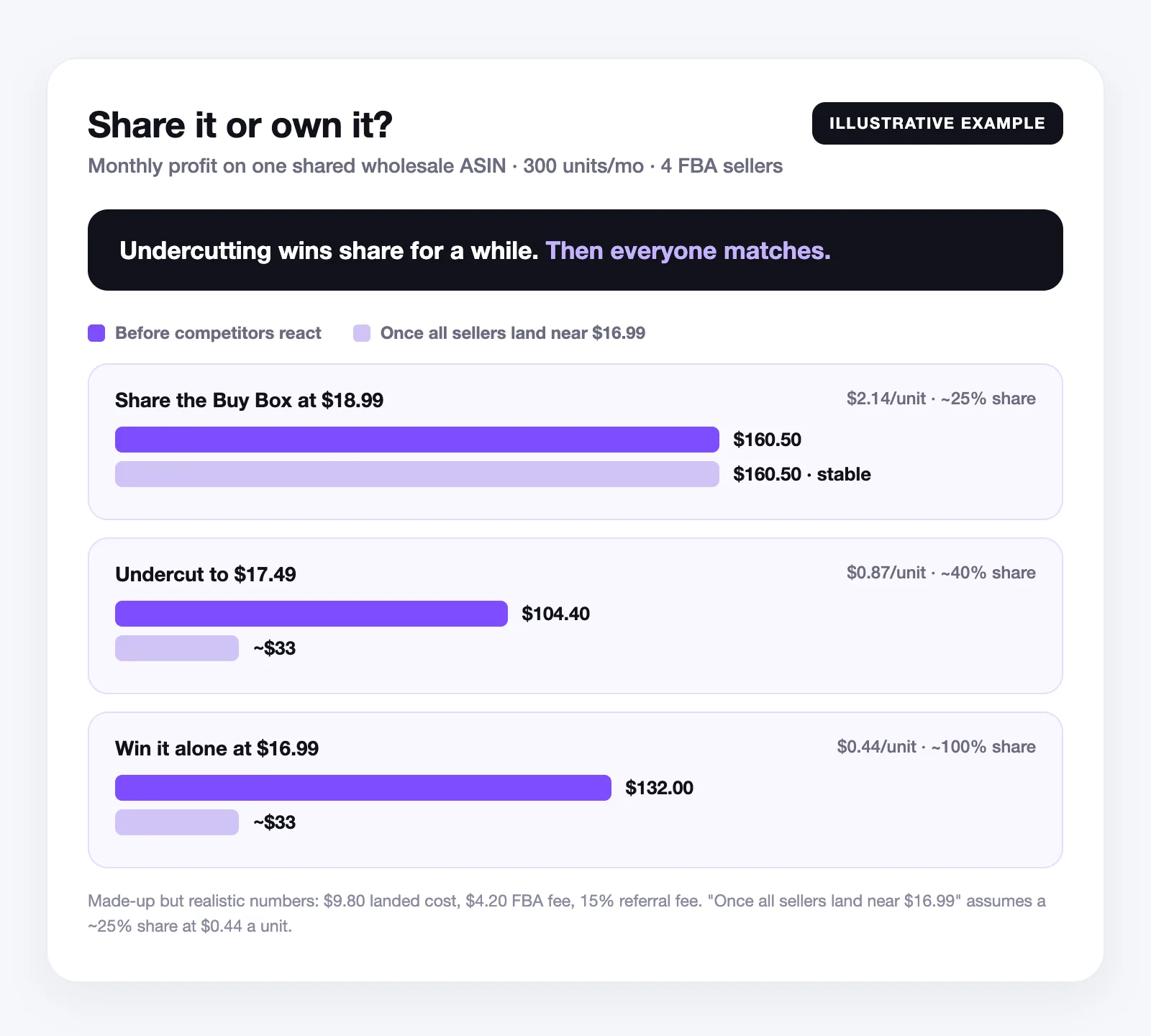
A wholesale ASIN sells about 300 units a month. There are seven sellers, four of them FBA, all priced around $18.99. Your landed cost is $9.80, your FBA fee is $4.20, and the referral fee is 15%.
| Strategy | Your price | Profit per unit | Your share of sales | Units | Monthly profit |
|---|---|---|---|---|---|
| Share the Buy Box at the going price | $18.99 | $2.14 | About 25% (one of four FBA sellers) | 75 | $160.50 |
| Undercut to $17.49; others follow partway | $17.49 | $0.87 | About 40% while it lasts | 120 | $104.40 |
| Win it alone at $16.99 | $16.99 | $0.44 | Close to 100% until others match | 300 | $132.00 |
Sharing at $18.99 earns the most, and it's the only option that stays stable. The other two invite every competitor's repricer to respond. Once they all land near $16.99, you're back to a 25% share, at $0.44 a unit instead of $2.14. That's about $33 a month on this ASIN instead of $160.50.
A short playbook: three strategies to start with
| Strategy | Use it for | The rule |
|---|---|---|
| Buy Box group match | Most wholesale listings | Match the lowest FBA price in the Buy Box group, never go below your min, and raise your price when competitors drop out |
| Amazon-aware hold | Listings where Amazon sells | Match Amazon or sit slightly above, and don't chase anyone pricing below Amazon |
| Thin-listing push | Listings with only one or two other sellers | Price toward the top of the band: there's less rotation to share and more room above you |
Start with these, check your Buy Box share and profit per ASIN after two weeks, and adjust from there.
Responsiveness and control over the rules are what wholesale sellers tend to care about most. Here's how Daniel "1000ASINs" Boufford, who runs a brand-direct wholesale business on Amazon and Walmart, described his switch to Flashpricer:
"I was paying $500–$800 a month and still felt a step behind. The repricing wasn't that responsive and I couldn't control much with the AI rules. I needed Amazon Canada, Walmart, and Amazon Business pricing, and Flashpricer had the same feature set for a fraction of the cost. My sales have gone up a lot since switching, and the UI is far simpler."
— Daniel "1000ASINs" Boufford, wholesale seller
Every seller, marketplace and listing is different, and past results don't guarantee future performance. For more on how Dan runs his operation, read 7 operator lessons from his webinar with Flashpricer.
How Flashpricer handles this
Flashpricer's wholesale repricer lets you build the rules above without walking your price down to the floor. You pick who you compete against (the Buy Box holder, the lowest FBA or FBM offer, or specific sellers), ignore offers you don't consider real competition, and choose the action: match, add or subtract, or hold. Dedicated rules cover the moments when you're the only seller left or a competitor goes out of stock. On the Pro plan and above, CH.AI competition-based Buy Box is included too (see plans).
Price changes push in under 30 seconds on every plan. Amazon can then take up to 4 minutes to publish them, the same for every repricer, so when a competitor runs out of stock your price heads back up without waiting on a slow repricing cycle.
The floor matters most in wholesale, and it moves with your supplier's prices. Flashpricer syncs your costs from your inventory tool every 30 minutes, recalculates your min and max with marketplace fees, and uses the greater of your MAP or your calculated min as the floor. See how profit protection works.
FAQ
What's the best repricing strategy for Amazon wholesale? Stay in the Buy Box rotation at a price that protects your margin. Match the lowest competitive FBA price, keep a firm min price, and raise your price when competitors go out of stock.
Do I need the lowest price to win the Buy Box on a shared listing? No. Amazon rotates the Buy Box among sellers with competitive offers. Being in that group matters more than being the cheapest.
How do I avoid a price war with other repricers? Match instead of undercutting, hold when you're already sharing the Buy Box, and set a min price that includes all fees and your required profit.
Should I compete with Amazon on a wholesale listing? Don't undercut Amazon. Match it or sit slightly above. You can often still share the Buy Box at Amazon's price.