Wholesale Repricing for Amazon Sellers: 7 Operator Lessons from a $90M Brand Direct Business
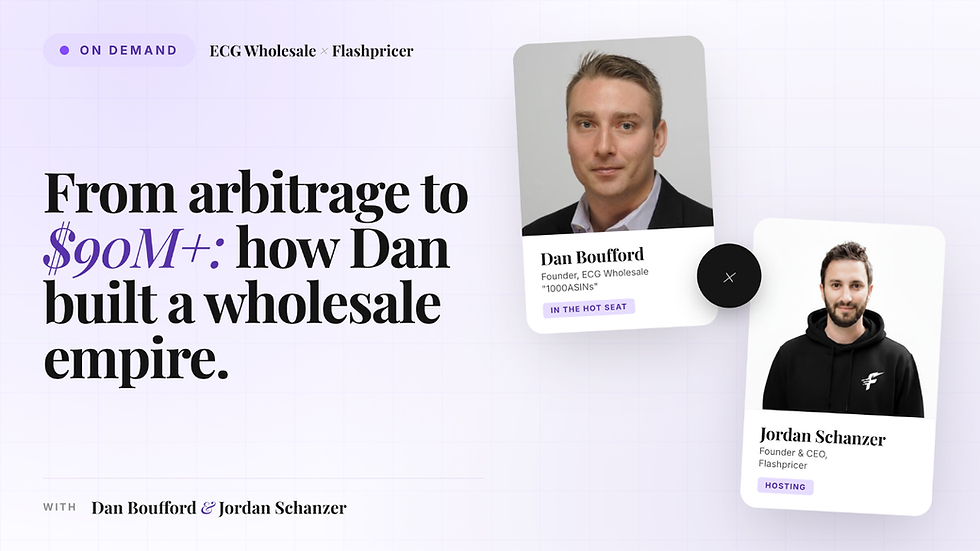
Dan "1000ASINs" Boufford sits down with Flashpricer founder Jordan Schanzer to break down the exact transition that took him from chasing OA and RA deals to running a brand-direct wholesale operation doing 7 figures a month on Amazon and Walmart.
Most Amazon sellers think about repricing in the context of online arbitrage — chasing the Buy Box on a listing they share with a dozen other resellers, all racing to the bottom. But the conversation changes completely once you move into brand direct wholesale, where you're buying authorized inventory, sometimes sharing a listing with only a handful of approved sellers, and managing thousands of SKUs across multiple channels.
That's the world Daniel "1000ASINs" Boufford operates in. He's done over $90 million in Amazon sales and is on pace for a $40–50M year, with roughly 75% of that coming from brand direct wholesale relationships. We sat down with Dan, hosted by Flashpricer founder and CEO Jordan Schanzer, to unpack how he made the jump from flipping clearance products out of his NYC apartment to running a wholesale operation he now manages remotely from Miami.
Below are the highest-leverage ideas from that discussion — the ones that actually change how you run inventory, pricing, and brand outreach — plus our own commentary on where repricing fits into a serious wholesale operation.
👉 Watch the full on-demand webinar here for the complete conversation.
Quick context: what the webinar covered
The session was an informal, fast-moving Q&A. Jordan asked the questions most sellers actually want answered — how to get your first brand account, what the outreach pitch should sound like, what software is non-negotiable, and how the economics of in-house prep compare to a 3PL. Dan answered as an operator, not a guru. No "launch a product, get rich in a month" promises. Just what's worked across nine years and tens of millions in sales.
1. Treat every product like a cash flow stream
Dan's screen name — 1000ASINs — comes from a simple piece of math he ran in his earliest arbitrage days. He'd sell something small, like a 2-pack of mints from Walmart, and track the monthly profit. A few SKUs netted him around $1,000/month. Multiplied across a year, that's $12,000 from products most sellers would ignore.
The mental model: every ASIN you keep in stock is a recurring cash flow stream. Get to 1,000 products netting even $100/month each, and you're at roughly $1M in annual profit. Brick by brick.
Why it matters for repricing: A cash-flow-stream mindset only works if your products stay competitive and in the Buy Box. A product that's priced wrong for even a few days leaks profit from the stream. At scale — thousands of SKUs — manual pricing is impossible, which is exactly why repricing becomes non-negotiable past about 10–20 SKUs.
2. The transition from arbitrage to wholesale doesn't have to be a clean break
A three-month account suspension over IP complaints nearly ended Dan's Amazon business early on. The products were authentic, sourced from national retailers, but the complaints piled up while he ignored emails he didn't understand. He got the account back, vowed to protect his account health, and made a decision: move to wholesale long term.
Crucially, he didn't quit arbitrage overnight. He kept a few safe, replenishable product lines running while he onboarded brand and distributor accounts one at a time. The percentages shifted over a few years until he was 100% wholesale (now roughly 75% brand direct, 25% distributors).
The takeaway for sellers: You can layer wholesale on top of an existing arbitrage business. You don't need to start from scratch.
3. You don't need huge capital — you need the right brands
One of the most useful myths Dan debunked: that wholesale requires deep pockets and industry connections. It's partly true — some brands gate their best pricing behind order tiers ($10K, $50K, $75K+), and the margins only work at the top tiers.
But there's a whole universe of small brands that will happily take a $1,000–$5,000 order where the pricing still works on Amazon. The trick is knowing which brands to contact. You're not calling Apple or Sony. You're calling niche brands with a handful of SKUs, sometimes run by a single owner who knows nothing about Amazon.
Reality check from Dan: Getting that first brand is the hardest part. You may have to contact 100, 200, even 500 brands. But once you have one or two, it gets dramatically easier — you have proof, a honed pitch, and credibility in the niche.
4. Stop pitching "give me an account." Start pitching growth.
This was the strategic core of the conversation. Dan explained the "pie chart" problem: a brand doing $100K/month online has a fixed sales pie. Adding reseller #6, #7, #8 doesn't grow the pie — it just slices it thinner, creates more administrative work, and increases the odds of a bad-apple seller breaking MAP or undercutting.
So when you call asking for an account, you sound like more work, not more revenue. The brands that ignore you aren't being difficult — they're being rational.
The winning angle is to show how you'll grow the pie:
Advertising (yes, even resellers can run profitable ads — more on that below)
SEO and listing discoverability
Better cover images, infographics, A+ content, video, UGC
Multi-channel expansion (Walmart, TikTok, eBay)
Amazon B2B / Walmart B2B as net-new revenue streams
A modern outreach tactic Dan highlighted: use AI tools to mock up a "before and after" of one of the brand's existing listings, then send it as a PDF. It shows you'll actually do the work — unlike the many resellers who promise the world and deliver nothing once they have the account.
Our commentary: Pricing is one of those growth levers, and it's the one most resellers ignore. Consistent Buy Box ownership through smart repricing directly increases a brand's sales velocity and ad efficiency.
5. Repricing and advertising work together — even for resellers
A lot of resellers assume ads are only for private label sellers who own their listings exclusively. Dan pushed back on this. He runs ads even when he's not the exclusive seller, as long as the margin supports it.
The key mechanic: Amazon ads are Buy Box aware. They won't spend when you're not in the Buy Box on a given keyword. So you bring products up in search, but you only pay when you're the one positioned to make the sale.
Why this is a repricing insight in disguise: Your ad spend efficiency is directly tied to how often you hold the Buy Box. A responsive repricer means your ads spend on impressions where you can actually convert. A laggy one means you're either missing the Buy Box (ads underperform) or leaving margin on the table.
6. The software stack: what's non-negotiable vs. what you add at scale
Dan was specific here. His recommended progression:
Day 1 essentials:
Keepa — indispensable for price/sales history
A profit calculator that overlays on listings
Sellerboard for inventory and analytics (syncs to QuickBooks; he stressed know your numbers from the start — many sellers think they're profitable but aren't after fees)
As you scale past ~10–20 SKUs:
A repricer becomes necessary, especially when prices fluctuate constantly
At larger scale:
Restock/forecasting software (he uses RestockPro; mentioned SoStocked as an alternative; Sellerboard's built-in forecasting is fine up to ~100 SKUs)
Inventory management software for warehouse/pallet tracking
On repricing specifically, Dan shared his own journey: he started on a basic repricer, moved to an expensive AI-based tool ($500–800/month), but found it wasn't responsive enough and the AI rules were hard to control. He demoed and switched to Flashpricer because it covered his exact needs — Amazon US, Amazon Canada, Walmart, and Amazon B2B pricing — at a fraction of the cost. He's reported a meaningful sales increase since switching, with about 10% of his sales now coming from Amazon Business customers.
7. In-house prep vs. 3PL: what he'd do differently
Asked directly whether he'd choose his own warehouse again, Dan was candid: if he could do it over, he'd probably use a 3PL, but he's "in too deep now."
The nuance: in-house prep saved him roughly 20% on prep costs and made sense for his high-volume, low-margin items (think $10 products with $1–1.50 gross profit, where giving a prep center half the profit doesn't pencil out). But it added enormous complexity — hiring, firing, managing employees, rent, overhead.
The honest tradeoff: more control and slightly cheaper, versus a lot more to manage. For most sellers starting out, a 3PL removes a massive operational burden.
Frequently asked questions
What is wholesale repricing? Wholesale repricing is the automated adjustment of prices for products you buy in bulk from brands or distributors and resell on marketplaces like Amazon and Walmart. Unlike one-off arbitrage flips, wholesale repricing manages recurring, replenishable inventory across many SKUs, optimizing for Buy Box ownership while protecting your margin floor on authorized products.
How is wholesale repricing different from OA (online arbitrage) repricing? The mechanics are similar — both aim to win the Buy Box — but the context differs. Arbitrage is often anonymous and one-time, with unpredictable competitor sets. Wholesale involves replenishable products, fewer (often authorized) sellers on a listing, MAP considerations from the brand, and the need to manage thousands of SKUs consistently over time. Wholesale repricing also frequently needs to handle B2B/business pricing tiers, which arbitrage rarely touches.
Can Walmart sellers use repricing? Yes. Walmart Marketplace has its own Buy Box dynamics, and repricers like Flashpricer support Walmart alongside Amazon US, Amazon Canada, and Amazon B2B. As Dan noted, Walmart is a worthwhile diversification channel — for some sellers it's 1–2% of sales, for others as much as 20%, depending on the product.
At what point do I actually need a repricer? Dan's rule of thumb: somewhere around 10–20 SKUs, especially if prices fluctuate frequently. Below that, manual pricing is manageable; above it, you're leaving money on the table and missing Buy Box opportunities without automation.
Do resellers benefit from running ads? Yes, when the margin supports it. Because Amazon ads are Buy Box aware, your spend is concentrated on moments when you can actually convert — making ads viable even when you're one of several authorized sellers on a listing.
The bottom line
The throughline across the whole conversation: wholesale at scale isn't about one clever hack. It's about treating products as cash flow streams, pitching genuine growth to brands instead of begging for accounts, and building the systems — pricing, prep, forecasting, multi-channel — that let the business run without you.
If you're sitting on an arbitrage business and wondering whether brand direct wholesale is worth the leap, Dan's path is a useful map: layer it on gradually, get that hard first account, and let the percentages shift.
👉 Watch the full on-demand webinar here — including the parts we didn't cover here on account suspensions, scaling pains, and the move from wholesale into brand ownership.
Have a question for Dan or the Flashpricer team? Email success@flashpricer.com.