

Your minimum price should equal your landed cost plus every marketplace fee plus the profit you require, divided by one minus the referral fee percentage. Your maximum price should be high enough to capture extra margin when you're the only seller, but not so high it looks like price gouging. Set both on every listing before you turn a repricer on.
The min price is the most important number in repricing. It's the line the repricer will never cross. Get it wrong and the software does exactly what you told it to: follows a competitor all the way down to a loss. Get it right and you can let the repricer fight as hard as it wants, because the worst case is a sale at your minimum profit.
The min price formula
Here it is:
Min price = (Landed cost + Fixed fees + Required profit) ÷ (1 − Referral fee %)
| Input | What goes in it |
|---|---|
| Landed cost | Everything it took to get the unit into the warehouse: purchase price, tax, inbound shipping, prep |
| Fixed fees | Fees that don't change with price: the FBA or WFS fulfillment fee, inbound placement, and a little for storage |
| Required profit | The least you'll accept per unit: a dollar amount ($3.00) or a return on cost (25%) |
| Referral fee % | The marketplace's cut of the sale price, set by category |
Either way of setting required profit works. Pick one and use it consistently.
Why divide by (1 − referral %)? Because the referral fee is a percentage of the sale price. If you just add 15% of your cost, you'll come up short, since the fee is charged on the higher sale price. Dividing gets it exact.
If you'd rather not do fee math by hand, our free WFS and FBA fee calculator works out the fees on a listing for you.
Setting max price so you don't overprice when you're the only seller
The max price matters most when competition disappears. If every other seller goes out of stock, a repricer will raise your price toward your max. That's good, up to a point.
Set the max too low and you leave money on the table when you're alone on the listing. Set it too high and shoppers won't buy, or the marketplace may stop showing your offer. Amazon can drop the Featured Offer when it doesn't see a price as competitive, and Walmart can unpublish an offer priced well above what the item sells for elsewhere. We cover that case in Your Listing Is Unpublished. Is Price Even the Problem?
A practical starting point: set the max a little above the highest price the item has sold at in the last 90 days. If you don't have that history, 1.5 times your min is a reasonable first guess. Then check it after a few weeks.
Peak season: when to raise the min instead of lowering it
Most sellers do the opposite of what makes sense in Q4. They lower their min to "compete" during Black Friday. But demand is higher, and a lot of the competition will sell through and drop off.
Raise your min when:
- The item sells well and you have limited stock you can't easily restock before December.
- Storage costs are about to jump. Amazon charges a higher monthly storage rate from October through December than the rest of the year (Amazon's storage fee page (opens in a new tab)).
- A competitor is clearly dumping inventory. Let them sell out at their low price, then win the Buy Box back at yours.
Lower your min on purpose only when you have too much stock and need to clear it before January. Do it for a set number of units, then put it back.
Common mistakes
- Min = cost. The most common one. If your min is what you paid, every sale at the min loses money once fees come out. On the example below, a sale at cost loses $8.16 a unit.
- Max = min. The repricer has no room to move. You can't raise your price when competitors leave, so you never capture the upside.
- One rule for the whole catalog. A 20% margin rule might be fine for a $40 item and a loss on a $9 item with a $3.45 fulfillment fee. Set mins per SKU, or at least per fee tier.
- Forgetting fees change. Amazon and Walmart both update fees during the year. A min set in January can be wrong by October.
Worked example with one SKU
Illustrative example: a made-up but realistic SKU.
You sell a set of silicone baking mats on Amazon through FBA. The Buy Box usually sits between $29.99 and $32.99, and the 90-day high was $36.49.
| Input | Amount |
|---|---|
| Landed cost | $12.40 |
| FBA fulfillment fee | $6.10 |
| Inbound placement fee | $0.20 |
| Referral fee | 15% |
| Required profit | $3.00 |
Storage is left out here to keep the numbers simple. In your own math, add a little for it.
Min price: ($12.40 + $6.10 + $0.20 + $3.00) ÷ 0.85 = $21.70 ÷ 0.85 = $25.53.
Check it: at $25.53, the referral fee is $3.83. $25.53 − $3.83 − $6.10 − $0.20 − $12.40 = $3.00. Exactly the profit you required.
Max price: $36.99, a little above the 90-day high.
What a min at cost would do: at $12.40, the referral fee is $1.86. $12.40 − $1.86 − $6.10 − $0.20 − $12.40 = −$8.16 per unit.
Peak-season version: from Thanksgiving week through mid-December, you want at least $5.00 a unit, since the item sells well and you can't restock until January. New min: ($12.40 + $6.10 + $0.20 + $5.00) ÷ 0.85 = $27.88.
Here are the three floors side by side:
| Min price set at | Sale price | Referral fee (15%) | FBA + placement | Landed cost | Profit per unit |
|---|---|---|---|---|---|
| Cost | $12.40 | $1.86 | $6.30 | $12.40 | −$8.16 |
| The formula, $3.00 profit | $25.53 | $3.83 | $6.30 | $12.40 | $3.00 |
| Peak season, $5.00 profit | $27.88 | $4.18 | $6.30 | $12.40 | $5.00 |
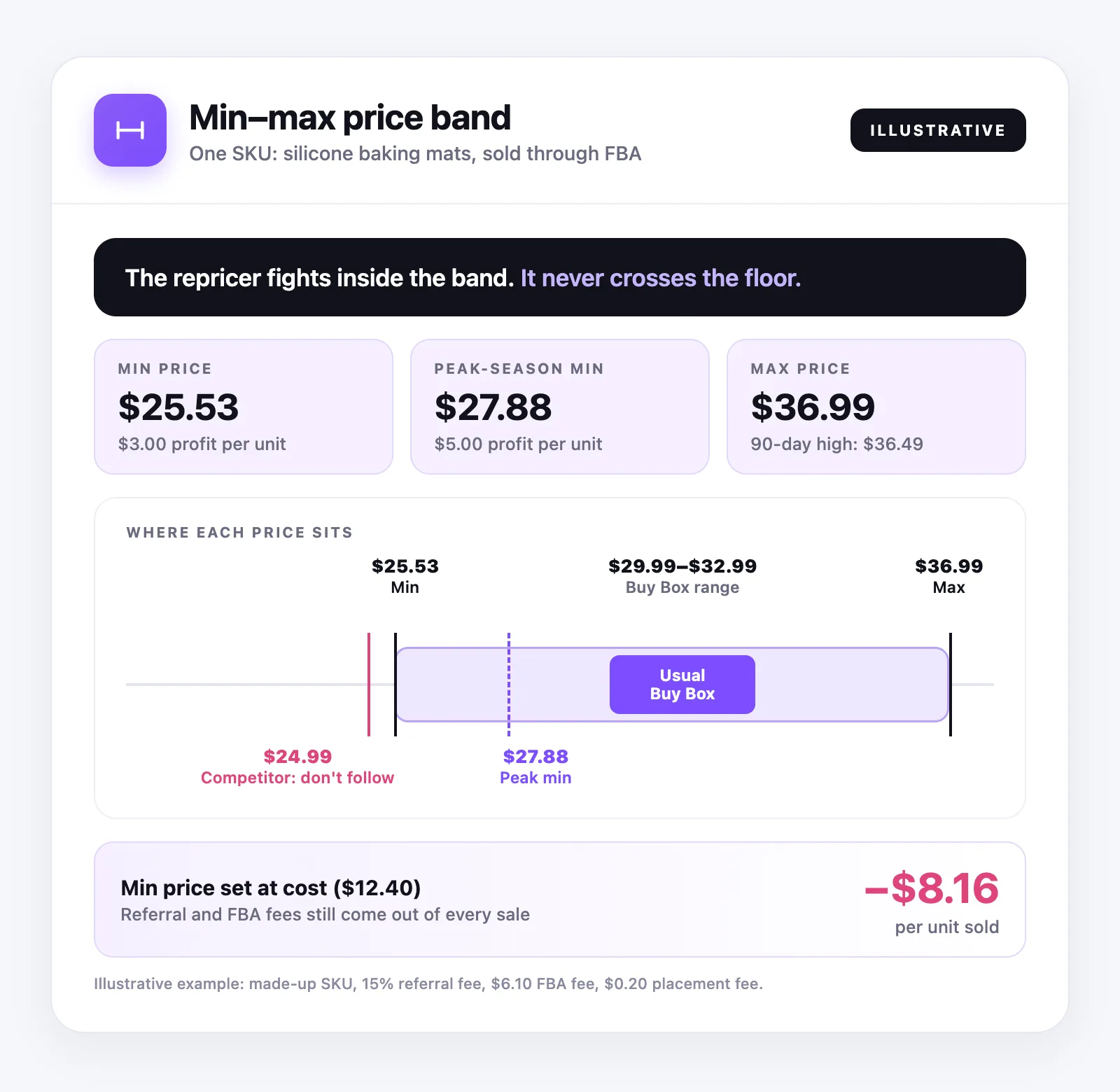
With a $27.88 min and a $36.99 max, the repricer can still compete for the Buy Box in the $29.99 to $32.99 range it usually sits in. If a competitor drops to $24.99 to clear stock, you don't follow. You wait.
How Flashpricer handles this
Flashpricer puts min and max prices on every listing and builds FBA, WFS and referral fees in automatically, so the floor reflects your real costs. You choose the method (ROI, profit margin or fixed profit per sale) and Flashpricer solves for the price that hits it, or you set min and max per SKU yourself. When your costs sync from your inventory system, the floor moves with them. Here's how profit protection works.
Setup takes about 15 minutes. If you haven't set your guardrails yet, start a free 14-day trial (no credit card required) and set them as you go. Plans start at $50 a month: see Flashpricer pricing. For arbitrage inventory specifically, see how sellers decide what to buy for retail arbitrage in 2026.
FAQ
How do I calculate my minimum price on Amazon? Add landed cost, fixed fees (FBA fulfillment, placement, storage) and the profit you require, then divide by one minus the referral fee percentage. For a 15% referral fee, divide by 0.85.
What should my max price be? A little above the highest price the item has sold for in the last 90 days. Without that history, start at about 1.5 times your min and adjust.
Should I lower my min price for Black Friday? Usually not. Demand is up and competitors sell through. Lower it only to clear inventory you can't sell by January, and only for a set number of units.
Can a repricer sell below my minimum price? A properly set repricer won't. The min price is the guardrail it never crosses, which is why the min needs to include every fee.